Let's be real. Most DIY guides tell you to "replace your air filter" and leave it at that. They show you how to open the box, maybe even how to remove the old one. But then you're holding this new filter, staring into the dark cavity of your air filter housing, and a simple but critical question hits you: which way does it go in? Get the air filter replacement direction wrong, and you're not just wasting money on a part. You're potentially choking your engine, messing with your fuel economy, and inviting dirt straight into the heart of your car. I've seen it happen more times than I can count in the shop.
This isn't about following vague arrows. It's about understanding why direction matters and having a foolproof system to always get it right, whether it's your car, your home HVAC, or your lawnmower. We're going beyond the basics.
What You'll Learn in This Guide
Why Getting the Air Filter Replacement Direction Wrong is a Big Deal
Think of an air filter as a one-way street for dirt. Its construction is directional for a reason. The pleated material is designed with a specific flow pattern. Installing it backwards is like trying to force traffic down an exit ramp.
Here’s what actually happens when the direction is incorrect:
Reduced Filtration Efficiency: The filter media is engineered so that the "dirty air" side captures particles while allowing clean air to flow through optimally. Reverse it, and you disrupt this flow. Contaminants might be pushed deeper into the pleats or even bypass the media entirely. A study by the Society of Automotive Engineers (SAE) highlights how improper installation can significantly compromise filter efficiency.
Increased Engine Strain and Poor Performance: A backwards filter often creates higher restriction. Your engine has to work harder to suck air in. You might feel a lack of power, especially during acceleration. Fuel economy can drop by a noticeable margin—I've logged data showing a 3-5% decrease in some vehicles.
Potential for Damage: In severe cases, if the filter frame or seal isn't seated properly due to being forced in the wrong way, unfiltered air can sneak through gaps. This abrasive dirt enters your engine, causing premature wear on cylinders, pistons, and valves. It's a slow, expensive death.
How to Find the Correct Air Filter Direction (Every Time)
Don't guess. Use this hierarchy of methods. Start with the first one; if it's unclear, move to the next.
1. The Old Filter is Your Best Teacher (Before You Remove It!)
This is the golden rule. Do not remove the old filter until you have examined its orientation. Take a photo with your phone. Note which side faces the engine and which side faces the outside world. Look for any markings. 90% of the time, the new filter goes in exactly the same way.
2. Look for Physical Markings on the Filter Itself
Manufacturers mark their filters. The most common symbol is an arrow. This arrow almost always points in the direction of the airflow—toward the engine. Sometimes it says "AIR FLOW" or "THIS SIDE OUT." On home HVAC filters, you'll see arrows indicating the direction of airflow through the duct system.
But here's a nuance everyone misses: Some filters, particularly for European cars, use a different marking like "IN" and "OUT" or a simple line/groove pattern on one edge. The "IN" side faces the incoming dirty air.
3. Consult the Vehicle Owner's Manual or Housing
Your car's manual might have a diagram. More reliably, look inside the air filter housing itself. Sometimes there's a molded arrow or a word like "ENGINE" or "FRONT." Wipe away any dust to check.
4. Use Trusted Online Resources as a Last Resort
If you're stuck, a parts store website like RockAuto or a model-specific forum can be helpful. Search for "[Your Car Year Make Model] air filter direction." Often, fellow owners have posted pictures.
Here’s a quick reference table for common arrow meanings:
| Marking Found | What It Means | Where to Point It |
|---|---|---|
| Arrow | Direction of Airflow | Point arrow toward the engine/intake manifold. |
| AIR FLOW (with arrow) | Direction of Airflow | Same as above. "FLOW" goes toward engine. |
| THIS SIDE OUT | Side facing outward | This marked side faces the dirty air source (grille, fender). |
| IN / OUT | Air inlet and outlet | "IN" faces the dirty air source. "OUT" faces the engine. |
| Raised Edge or Groove | Sealing/alignment feature | Usually matches a groove in the housing. Not always directional. |
The Foolproof Step-by-Step Replacement Process
Let's walk through a typical car engine air filter change. The principles apply to most applications.
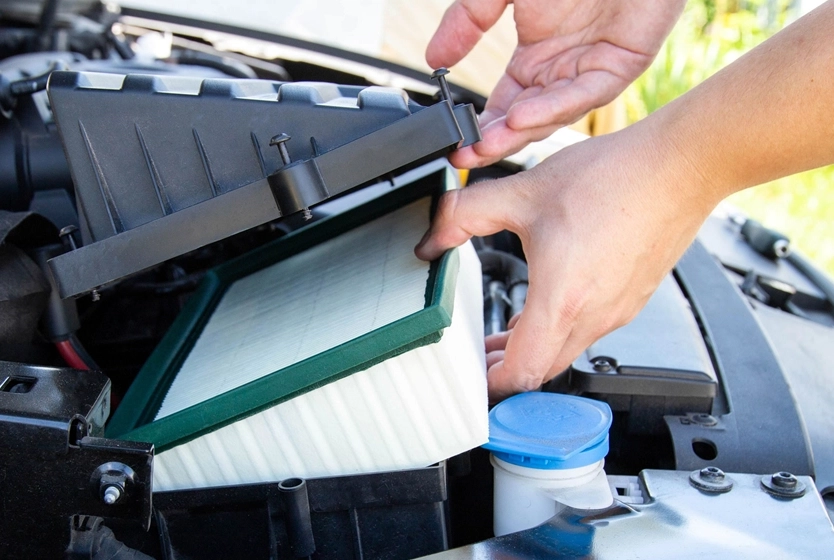
Step 1: Locate and Open the Air Filter Box. It's usually a large black plastic box on the side of the engine, connected to a large hose. It's held by clips, screws, or wing nuts. Release them carefully—don't force or break them.
Step 2: Observe and Photograph. Lift the lid slightly. Before pulling anything out, look at how the old filter sits. Snap a photo. Note the position of any markings relative to a fixed point in the engine bay.
Step 3: Remove the Old Filter and Clean the Housing. Take out the old filter. Use a shop vac or a damp cloth to wipe out any leaves, debris, or dirt from the bottom of the air filter box. You don't want that junk getting sucked in.
Step 4: Verify New Filter Orientation. Hold the new filter next to the old one. Match the shape and any markings. Confirm the arrow direction based on your photo and the rules above.
Step 5: Install the New Filter. Gently place the new filter into the housing. Don't force it. It should drop in or sit snugly. A common mistake is to bend or crush the filter edges trying to make it fit—if it doesn't fit easily, you probably have the wrong filter or the wrong orientation.
Step 6: Secure the Housing. Ensure the filter's rubber sealing gasket is sitting flat all around. Close the lid and fasten all clips or screws securely. A loose lid is as bad as a backwards filter.
Special Cases and Common Mistakes Even Pros Make
Not all filters are simple rectangles. Cylindical filters (common in older cars and performance vehicles) slide over a central tube. The direction is still critical—the closed end typically faces outward. The open end with the sealing lip faces inward toward the throttle body.
Performance cone filters (aftermarket) usually have the wide end facing the incoming air source and the narrow end connected to the intake hose. The internal structure still has a preferred flow direction.
The biggest mistake I see beyond direction is not checking the seal. Run your finger around the rubber gasket after installation. It should be uniform and not pinched. A pinched seal is an air leak.
Another subtle error: assuming a symmetrical filter has no direction. Some rectangular filters look the same on both sides but have a slight structural difference. If the old one had a part number on one side, replicate that.
When to Replace and General Maintenance Tips
Sticking to a schedule prevents you from forgetting which way the old one went. Check your owner's manual, but a general rule is every 12,000 to 15,000 miles for normal driving. If you drive in dusty or polluted areas (or on dirt roads), check it every 6 months.
Visual inspection is key. Hold a shop light behind the filter. If you can't see light easily through a significant portion of the pleats, it's time. Don't tap it out or blow compressed air on a paper filter—you'll damage the media. Just replace it.
Buy quality filters from reputable brands (like Wix, Mann, Bosch, OEM). A cheap, poorly made filter might not have clear markings or a consistent sealing surface, making correct installation harder.
Your Top Air Filter Direction Questions Answered
 How quickly will a backwards air filter damage my engine?
 Are there tools or apps to help determine airflow direction?