Inside This Guide
- What Does a Cabin Air Filter Actually Do in a Honda Civic?
- Spotting the Signs: When Your Civic's Filter Needs Changing
- The Hunt: Finding the Cabin Air Filter Honda Civic Hiding Spot
- The Great Filter Face-Off: Picking the Best Cabin Air Filter for Your Honda Civic
- The Step-by-Step Swap: Your Honda Civic Cabin Air Filter Replacement
- Beyond the Basics: Common Questions & Headaches Solved
- Why This Tiny Maintenance Task Matters More Than You Think
Let's talk about something you probably forget exists until you turn on the fan and get a face full of dusty, funky air. Yeah, that's your Honda Civic's cabin air filter waving a white flag. I've been there – sitting in my 2012 Civic, wondering why the "fresh air" setting smelled vaguely of old gym socks and wet leaves. It's not the car's fault. It's just begging for a little maintenance love.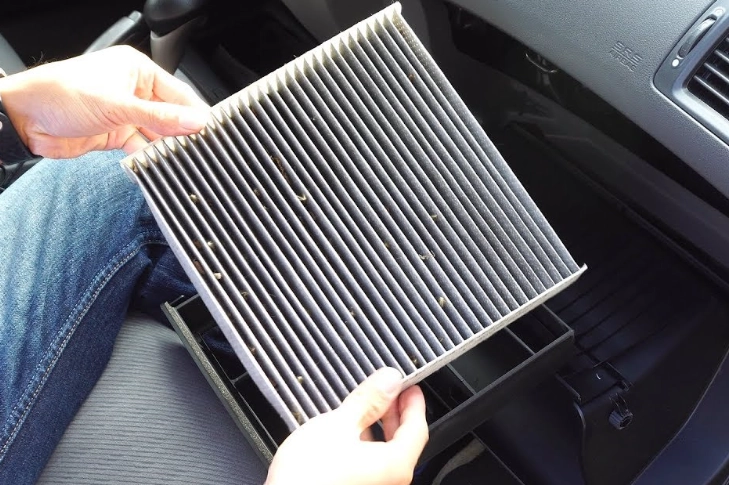
Replacing the cabin air filter in a Honda Civic is one of those jobs that seems mysterious but is honestly easier than assembling IKEA furniture (and way less frustrating). Whether you're a seasoned DIYer or someone who gets nervous opening the hood, this guide will walk you through the whole thing. We'll dig into where it hides, how to swap it without breaking a sweat (or any clips), which brands are actually worth your money, and how to tell if yours is crying for help. Forget the dealership markup on this simple part. You've got this.
What Does a Cabin Air Filter Actually Do in a Honda Civic?
Think of it as your car's built-in mask. Every time you run the fan, heater, or air conditioner, outside air is sucked into the HVAC system. The cabin air filter Honda Civic models rely on is a pleated piece of material (usually a combo of paper, activated carbon, or other synthetics) that traps contaminants before that air blows onto you and your passengers.
Here’s the junk it catches:
- Dust and dirt: The obvious one. Basic road grime.
- Pollen and spores: A lifesaver for seasonal allergy sufferers.
- Exhaust soot and smog particles: Crucial if you do a lot of city or highway driving.
- Mold and bacteria: Can grow on a damp, old filter, making smells worse.
- Leaf debris and insects: Somehow, those tiny bits always find a way in.
A clogged filter doesn't just dirty the air. It makes your blower motor work harder (potentially shortening its life), reduces airflow (so your AC or heat feels weaker), and can even lead to musty odors because moisture gets trapped in all that gunk. Not ideal.
Spotting the Signs: When Your Civic's Filter Needs Changing
Honda's official maintenance minder will eventually pop up a code for it, but you shouldn't wait for a light on the dash. Your nose and ears are better sensors. Here’s what to watch (and smell) for:
- Reduced airflow from the vents even on the highest fan setting. It feels like the blower is struggling.
- Increased window fogging. A dirty filter can mess with the HVAC system's ability to manage humidity inside the cabin.
- Whistling or unusual noises from the glovebox area when the fan is on. Air is fighting its way through a clog.
- Excessive dust on the dashboard shortly after cleaning. If dust is blowing past the filter, it's not doing its job.
- General bad odors, especially when first turning on the system. Smoke, exhaust, or outside smells come in more easily.
Time is also a factor. Even if you don't drive much, a filter sitting in a damp environment for two years can get moldy. The old rule of thumb of 15,000 miles or once a year is a good starting point, but it depends heavily on your environment. Drive on dirt roads or in a high-pollen area? Check it every 6 months.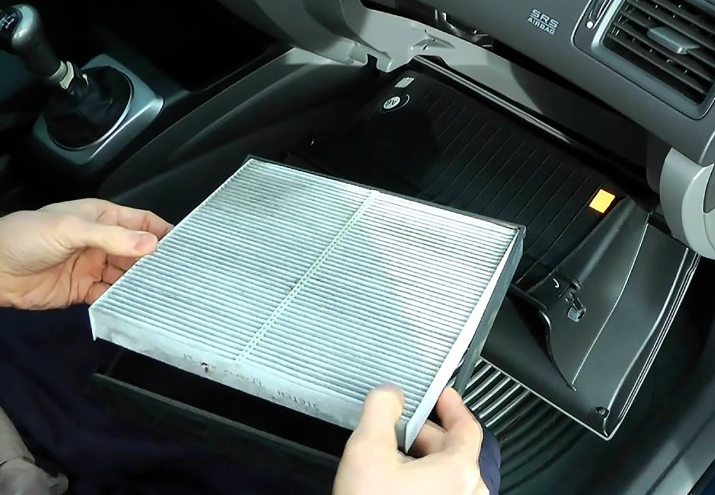
The Hunt: Finding the Cabin Air Filter Honda Civic Hiding Spot
This is where people get tripped up. It's not under the hood. For almost every Honda Civic from the late 90s to the current generation, the filter lives behind the glovebox. Honda tucked it away in the passenger footwell to make it a user-serviceable item without tools (in most cases). Pretty thoughtful, actually.
The access is slightly different between generations, but the concept is the same. Let's break it down by the most common models you'll see on the road.
For 8th, 9th, and 10th Generation Civics (2006-2022 roughly)
This covers a huge chunk of Civics out there. The process is famously simple.
- Open the glovebox all the way.
- Look at the sides of the glovebox interior. You'll see a little "stop" or damper arm on the right side. Gently flex the right side of the glovebox inward to unhook this arm.
- On both the left and right sides, you'll see tabs or stoppers that hold the glovebox in place when it's down. Squeeze the sides of the glovebox together to clear these stoppers and let the glovebox swing down completely. It will hang by its door strap. Don't yank it, just let it down gently.
- Staring right at you is a rectangular plastic cover, usually with two or three tabs. Press the tabs to release the cover and remove it.
- Voila! The white or off-white frame of the Honda Civic cabin air filter is right there. Slide the old one out, noting the direction of the airflow arrows printed on its frame.
For 11th Generation Civics (2023-Present)
Honda changed it up slightly on the newest models. It's still behind the glovebox, but the glovebox removal is a bit more involved, sometimes requiring a tool to remove a pin for the damper. Honestly, for the very latest models, it's worth a quick peek at your owner's manual for the official method, as it can vary by model year. The core idea – accessing it from the passenger footwell – remains the same.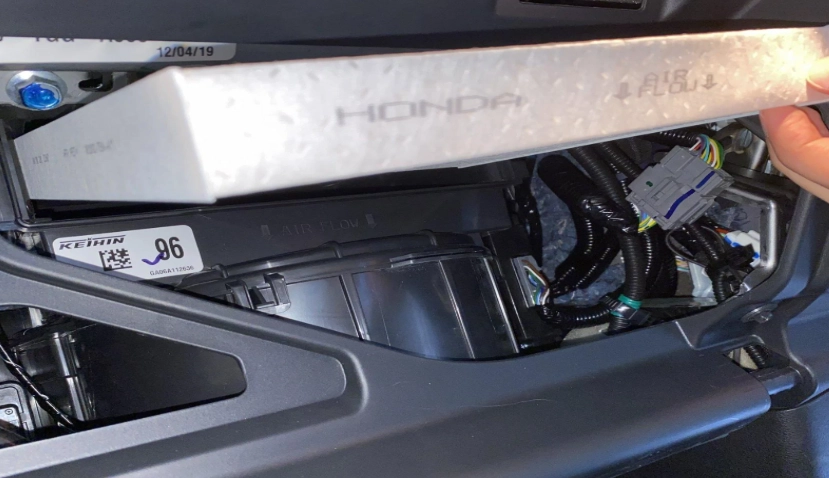
The Great Filter Face-Off: Picking the Best Cabin Air Filter for Your Honda Civic
Walk into any auto parts store or browse online, and you'll be bombarded with choices. They're not all the same. The price can range from $10 to $40+. Here’s the real breakdown of what you're paying for.
| Filter Type | What It Is | Best For | My Personal Take |
|---|---|---|---|
| Basic Particulate (Paper/Poly) | The standard filter. Like a coffee filter for dust and pollen. | Drivers in clean, rural areas. The budget pick. | It does the bare minimum. If you're just ticking a maintenance box, it's fine. But for a few bucks more, you can do better. |
| Activated Carbon | The basic filter plus a layer of activated charcoal embedded in it. | City drivers, anyone who wants to reduce odors and exhaust fumes. The most popular upgrade. | This is my go-to recommendation for 90% of Civic owners. The carbon genuinely helps with smells (like when you're behind a diesel truck) without restricting airflow much. The best value-for-money upgrade. |
| Allergy & Electrostatic | Advanced synthetic materials that use static charge to trap ultra-fine particles. | Allergy and asthma sufferers. People in areas with high pollution or wildfire smoke. | Brands like FRAM Fresh Breeze or Bosch PureAir. They're excellent and can trap smaller particles than carbon. If air quality is a major health concern for you, this is the choice. |
Brands? Stick with the known players: WIX, FRAM, Bosch, EPAuto, and of course, Honda Genuine parts. The OEM Honda filter is usually a good quality carbon filter. Aftermarket brands are perfectly fine and often offer more variety. I've used EPAuto filters (found cheaply online) in my own Civic for years with zero issues.
Avoid the absolute cheapest no-name filters on eBay. Sometimes they don't fit quite right, or the sealing frame is flimsy, letting dirty air bypass the filter entirely. That defeats the whole purpose.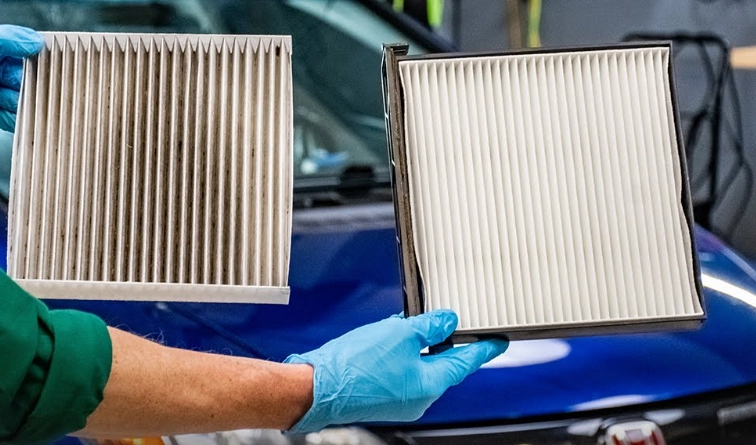
The Step-by-Step Swap: Your Honda Civic Cabin Air Filter Replacement
Let's do this. Assuming you have a common 8th-10th gen Civic, here’s the full walkthrough. You'll need: your new filter, a vacuum cleaner (optional but helpful), and maybe a flashlight. That's it. No tools.
Follow the glovebox dropping steps we talked about earlier. Once you have the filter cover off and the old filter exposed, here's the crucial part.
Vacuum the housing. Take your vacuum hose with a crevice tool and gently suck out any leaves, dead bugs, and loose dirt sitting in the filter compartment. This prevents that debris from immediately dirtying your new cabin air filter Honda Civic replacement. It's a five-second step that makes a real difference.
Now, look at your old filter. See the airflow arrows? The new filter will have identical arrows. They must point DOWNWARD or TOWARDS THE FLOOR when installed. This is the direction of airflow—from the outside intake (usually near the windshield cowl) down through the filter and into the blower motor. If you install it backwards, it will still work somewhat, but not nearly as well.
Slide the new filter in, arrows down. It should go in smoothly. If it's catching, don't force it. Double-check you have the right part number and that it's oriented correctly. Replace the plastic cover until the tabs click. Then, simply lift the glovebox back into position, hook the side stoppers back in place, and re-engage the damper arm on the right side. Close it up.
You're done. Seriously, that's it. The whole job takes 5-10 minutes for a first-timer.
Beyond the Basics: Common Questions & Headaches Solved
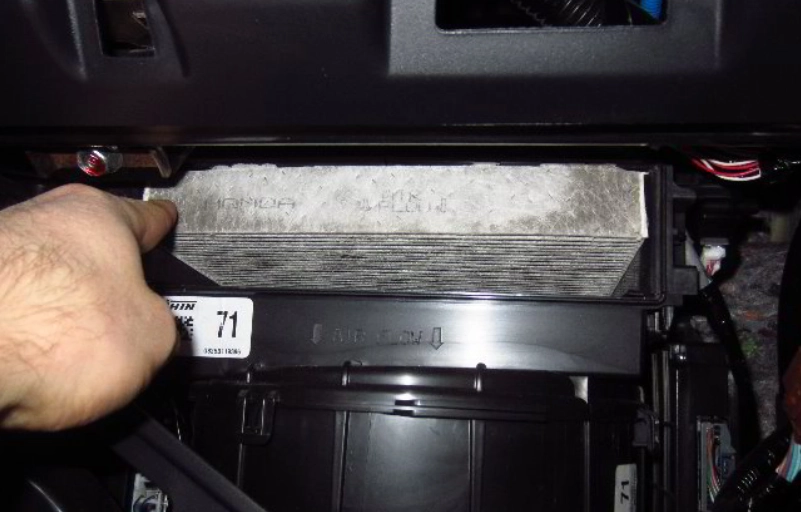
Yes, that's a problem. A wet Honda Civic cabin air filter housing usually points to a clogged drain tube for the AC system. The AC creates condensation that normally drains under the car. If that tube is blocked, water can back up into the blower motor area and soak the filter. This leads to terrible moldy smells. If you see water, you might need to clear the drain tube—a topic for another guide, but a common issue worth knowing about.
I don't recommend it. You can't effectively clean the microscopic pores in the filter media. Tapping it out or blowing compressed air on it might remove some surface dirt, but it won't restore its ability to trap fine particles or odors. These are disposable parts designed for replacement. Given the low cost, just swap in a new one.
Unfortunately, yes, for dealer service. That price includes a markup on the part (often the OEM carbon filter, which is good) and labor billed at shop rates. Now that you know the cabin air filter Honda Civic location and process, you see why doing it yourself for $20-$30 feels so satisfying. You're paying for convenience at the dealer.
Not directly on gas mileage. However, a severely clogged filter makes the blower motor draw more electrical current to push air, which is a tiny, tiny load on the alternator. The real hit is to comfort. Your AC won't cool as effectively if airflow is restricted, because the cold air can't circulate well. Your heater will also be weaker in the winter. So, while not a mpg killer, it's a comfort killer.
Why This Tiny Maintenance Task Matters More Than You Think
Look, changing a cabin air filter Honda Civic owners often ignore isn't going to make your car faster or last 100,000 miles longer. But it's a core piece of preventative care that has a direct, immediate impact on your driving experience. You spend hours in that cabin. The air you breathe shouldn't be an afterthought.
For allergy folks, it's a game-changer during pollen season. For city drivers, that layer of carbon takes the edge off traffic fumes. And for everyone, it keeps your HVAC system running as it was designed, preventing musty smells and ensuring good airflow.
It's also a gateway DIY job. Successfully doing this simple task often gives people the confidence to tackle the next thing—maybe an engine air filter, or cabin fuse replacement. It demystifies your car.